Unlock healing: 20% off today!
Post-Election Trauma Is Real… and It’s Not Just About Politics
Post-election trauma isn’t about politics alone, it’s about safety, identity, and the quiet grief that surfaces when values collide with reality. In this article, we explore why so many people are feeling anxious, disoriented, or emotionally exhausted after the election, and why those reactions are not only valid but predictable. Written from a clinical, trauma-informed perspective, this piece names what’s happening in the nervous system, why “just move on” doesn’t work, and what actually helps when the world suddenly feels unstable. If you’re struggling to regain your footing after the election, this is a grounded place to begin.
2/10/20263 min read
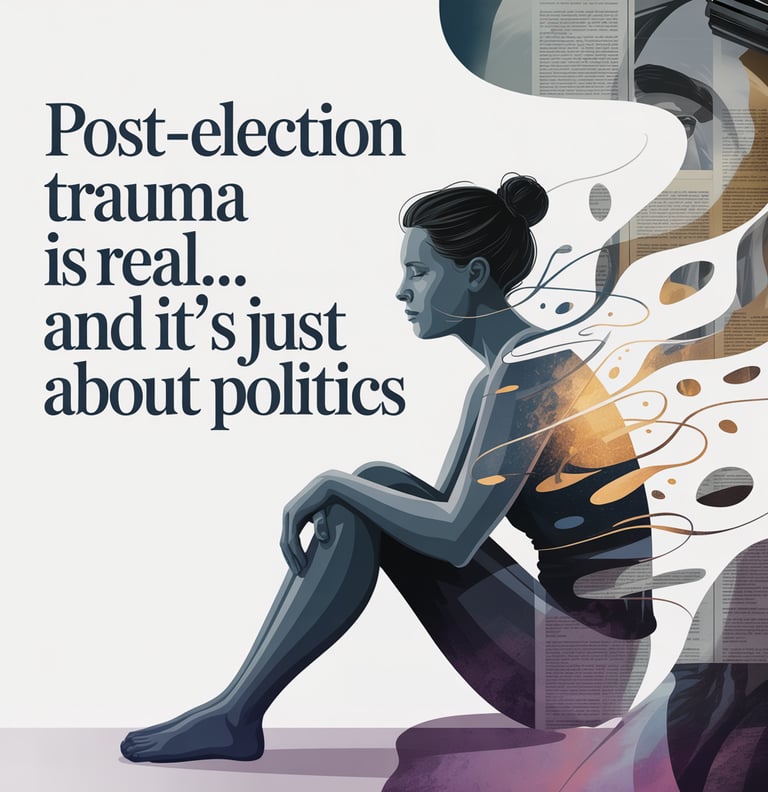
Post-Election Trauma Is Real and It’s Not Just About Politics
If you’re feeling disoriented, exhausted, angry, numb, hyper-vigilant, or quietly grieving right now, let’s start here:
You’re not weak.
You’re not dramatic.
And you’re not “too online.”
You’re responding to a threat to meaning, safety, and moral order.
That’s trauma.
Post-election trauma isn’t just about who won or lost. It’s about what the election symbolized… and what it threatened to take away.
For many people, this moment cracked something open that had already been under strain for years.
Why This Feels So Personal Even If You Didn’t Want It To
Elections used to be about policy.
Now they’re about identity.
Who belongs.
Whose lives matter.
Whose pain counts.
Whose truth is real.
When political movements merge with religion, nationalism, or authoritarian certainty, the nervous system doesn’t experience it as “disagreement.”
It experiences it as danger.
That’s why you’re seeing:
spikes in anxiety and panic
resurfacing religious trauma
grief reactions that feel outsized
rage that surprises people who “aren’t angry types”
dissociation, doom-scrolling, or emotional shutdown
Your body is trying to protect you from a future that suddenly feels unstable.
The Quiet Grief No One Is Naming
For many people, especially those who grew up in religious or moral frameworks that once promised safety, this moment feels like betrayal.
You may be grieving:
the loss of a country you thought you lived in
the loss of a faith community that no longer feels safe
the realization that compassion is not a shared value
the collapse of the belief that “we’re better than this”
That grief doesn’t show up neatly.
It shows up as irritability.
As withdrawal.
As a sense that something is deeply wrong but hard to articulate.
That doesn’t mean you’re broken.
It means you’re awake.
This Is Not a Debate… It’s a Nervous System Injury
Here’s the part that matters clinically.
When people say, “It’s just politics,” they’re missing the point.
Chronic exposure to:
dehumanizing rhetoric
moral absolutism
religious justification for harm
threats to bodily autonomy or civil rights
activates the same trauma pathways we see in prolonged stress and moral injury.
This is why logic doesn’t calm you down.
This is why “just turn it off” doesn’t work.
This is why even good news doesn’t fully settle your body.
You can’t cognitive-behavior your way out of a nervous system that feels under siege.
What Actually Helps And What Doesn’t
What doesn’t help:
minimizing your reaction
forcing positivity
arguing with people who aren’t listening
shaming yourself for caring
pretending this didn’t change you
What does help:
naming the injury accurately
grounding in reality instead of spiraling narratives
reconnecting with values instead of outcomes
creating psychological boundaries
processing grief without rushing to resolution
Healing doesn’t mean disengaging from the world.
It means regulating enough to stay human in it.
Why Post-Election Trauma Needs Its Own Language
One of the hardest parts of this moment is that people feel alone in it.
There isn’t a clear diagnosis.
There isn’t a socially accepted script.
And there’s often pressure to “move on” before the body has caught up.
Post-election trauma sits at the intersection of:
collective trauma
moral injury
religious deconstruction
identity threat
anticipatory grief
That’s not something you “get over.”
It’s something you work through.
A Word for the Ones Who Feel Spiritually Disoriented
If your faith, spirituality, or moral framework feels shaken, you’re not failing.
You’re responding to the collision between:
what you were taught was sacred
and how power is being wielded now
Many people are realizing they don’t want certainty anymore.
They want integrity.
They want compassion without conditions.
They want a faith or value system that doesn’t require denying reality or other people’s humanity.
That reckoning hurts.
And it’s also honest.
You Don’t Need to Do This Alone
At Post-Election Trauma, we created resources specifically for this moment.
Not to tell you what to think.
Not to gaslight your reactions.
Not to rush you toward acceptance.
But to help you:
stabilize your nervous system
name what you’re experiencing
process grief and anger safely
reconnect with your values
regain a sense of agency and clarity
This is support for people who are paying attention… and feeling the cost of that awareness.
Get support for post-election trauma with our Post-Election Trauma Coping Handbook
Healing
Reclaim peace, purpose, and resilience in the aftermath of political trauma.
Guide
© 2025. All rights reserved.